
Anatolia
Data Sphere
Advancing regional development through high-fidelity economic data and rigorous policy analytics. We transform raw territorial metrics into the primary evidence base for institutional decision-making across the peninsula.

Provinces mapped with longitudinal depth
Territorial Intelligence Ecosystem
Select a strategic zone to review current regional development indices and localized economic productivity trends based on the Q1 2026 reporting cycle.
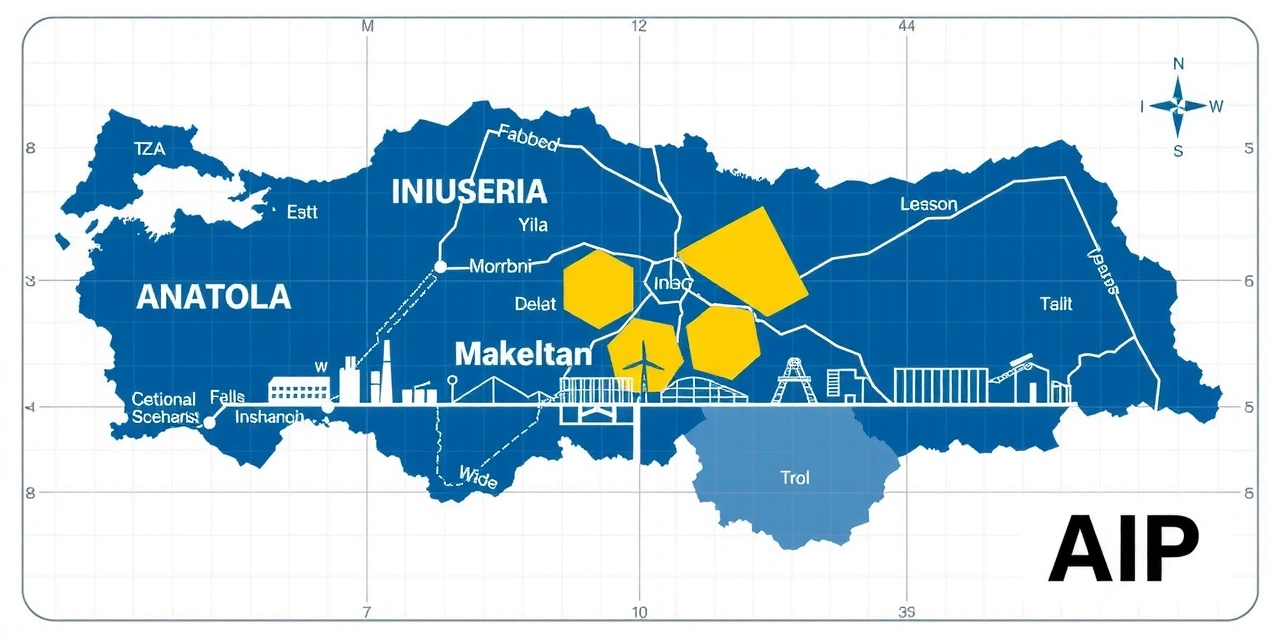
Inland Logistics Core
Consolidated data from Ankara and Konya industrial corridors showing a 4.2% increase in regional development efficiency.
Export-to-import ratio across secondary manufacturing sectors.
- Urban clustering optimization models
- Transit-oriented development feasibility

Maritime Commerce Hubs
Institutional analytics for Mersin and Izmir port operations reaching peak digital integration milestones.
Customs throughput score against Mediterranean regional benchmarks.
- Supply chain resilience auditing
- Sustainable tourism economic data

Energy & Resource Frontier
Strategic resource management data focusing on renewable energy output and agricultural technology adoption.
Year-on-year increase in renewable energy grid contribution.
- Agro-economic policy analytics
- Water management data governance
Structural Integrity of Economic Evidence
At Anatolia Data Sphere, we treat data like infrastructure. It is not merely information; it is the foundation upon which multi-billion dollar policy decisions are constructed. Our institutional research focuses on three primary pillars of verification.
Longitudinal Resilience
Our datasets span decade-long intervals, allowing policy makers to identify cyclical patterns in regional development that short-term analytics often miss. We prioritize the "long view" over market noise.
Granular Specificity
Economic data is only useful when localized. We map down to the sub-district level, ensuring that municipal interventions are targeted for maximum fiscal efficiency.


The Methodology Dialogue
Exploring the bridge between data science and public interest with the Anatolia Data Sphere research cohort.
Question: Institutional Integrity
"How does Anatolia Data Sphere ensure that policy analytics remain objective in highly contested economic landscapes?"
Our independence is structurally protected through a multi-vendor data sourcing strategy and an open-review data governance framework. We do not rely on singular government feeds; instead, we triangulate economic data from satellite imagery, port traffic, financial transaction volumes, and independent municipal registries. This layered approach ensures that the output is resistant to external narrative pressures.
Question: Accessibility vs. Depth
"Is regional development data accessible to non-technical stakeholders?"
Our Analytics Portfolio is designed with a dual-layer interface. Regional directors can access high-level executive summaries that distill complex trends into actionable policy levers, while researchers can dive into the raw JSON or CSV outputs for deep-dive modeling. We believe transparency in regional development is a public service.
Institutional Data Coverage Intensity
High-Value Engagement
Our platform is optimized for institutions that require verifiable regional development data for long-term planning.
- Municipal planning departments seeking infrastructure ROI models
- Investment firms requiring rigorous economic policy analytics
- Academic researchers focusing on territorial development
Boundary Parameters
We maintain a strict focus on institutional and regional data; we are not a general-market news or consumer advisory service.
- Generalized national consumer sentiment surveys
- Unverified crowdsourced economic projections
Ready to integrate authoritative data?
Connect with our advisory team in Ankara to discuss bespoke data governance strategies or to schedule a full demonstration of the Anatolia Data Sphere analytics engine.